Nursery · Materials & safety
What Makes a Crib Mattress Firm? A Closer Look at Obasan’s Natural Materials
A crib mattress’s firmness is not a matter of plushness or personal taste. It is a feature of the mattress’s structure—and a central consideration when preparing a sleep space for an infant. In the Obasan Organic Crib Mattress, an extra-firm Dunlop latex layer and a coconut-fiber base form the support system, while wool and cotton play different roles around it.
Published November 5, 2026
Firmness begins beneath the cover
Press a hand into a mattress and the first impression may come from its cover, quilting or surface layer. That impression is not the whole story. A crib mattress’s firmness depends principally on its internal construction: the materials in the core, how they are layered, how densely they are built and how well the finished mattress resists compression.
For an infant sleep surface, “firm” does not mean hard in the everyday sense, nor does it mean that every mattress will feel identical. It means the surface is designed to remain relatively level and supportive rather than deeply yielding under a baby’s weight. A soft surface can conform around the face or body; a firm one is intended to limit that sink. The distinction is important enough that caregivers should follow current safe-sleep recommendations and the mattress manufacturer’s directions, rather than relying on a quick touch test alone.
There is no dependable home substitute for product testing and compliance with applicable safety requirements. Pressing a mattress with a palm may help someone understand its feel, but it cannot establish that a model meets a standard. Nor does the word “organic” by itself indicate firmness or certify that a mattress is appropriate for a particular crib. Materials, construction, labeling and correct fit all matter.
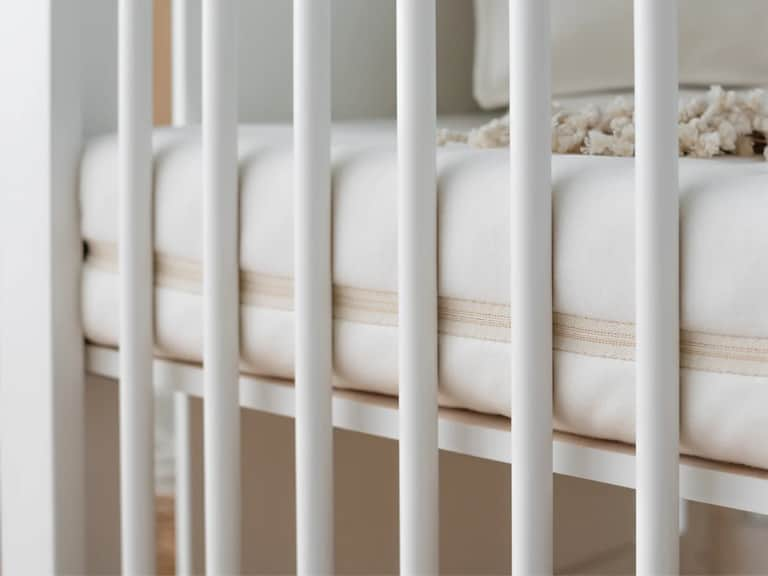
The Obasan Organic Crib Mattress offers a clear example of how a natural-material design can build a supportive core without treating every component as if it did the same job. Its listed construction includes a two-inch extra-firm organic Dunlop latex layer and a two-inch rubberized coconut-fiber base, alongside wool and cotton. The result is a layered design, not a single material asked to do everything.
The architecture of a supportive surface
Think of a crib mattress as a small system. The base provides structural resistance; the upper core contributes support and response; the cover protects the interior and can affect how the surface feels. In the Obasan design, the latex and coconut fiber are the key materials described as creating the firm support. Wool and cotton contribute other qualities, including moisture management and a fabric enclosure.
That division of labor matters. A mattress can contain natural fibers and still vary in firmness according to its construction. A thick, soft quilted top, for instance, changes the feel of a sleep surface even if the material beneath it is firm. Conversely, a firm core is not a reason to add a cushion or topper. For infant sleep, caregivers should use the mattress as intended and avoid adding unapproved padding, pillows or other soft bedding.
Obasan describes its crib mattress as having two two-inch layers. It is listed at 28 by 52 inches and 4.5 inches thick, dimensions intended for standard North American cribs. Before use, check the mattress label and the crib instructions, and confirm that the specific mattress fits the specific crib. A product’s stated standard size is useful information, not a substitute for checking the fit in the assembled sleep space.
Dunlop latex: resilience, not softness
Latex is often discussed as a comfort material, but its behavior depends on its formulation and density. In the Obasan mattress, the relevant detail is not simply that it contains latex: the product description identifies an extra-firm layer of organic Dunlop latex. The word “extra-firm” describes the intended character of that layer; it is not a universal rating that can be compared directly with every other manufacturer’s terminology.
Dunlop is a method of producing latex foam. The resulting material is resilient: it compresses under pressure and pushes back as pressure is removed. How firm it feels depends on the specific formulation and the way the component is made and used. In a crib mattress, the design goal is a stable, supportive surface, not the contouring sensation some adults seek in a softer mattress.
Material labels can help readers understand what is in a product, but they do not tell the whole safety story. An organic certification relates to defined standards for the material or product scope covered by that certification. It should not be treated as proof of every possible claim about health, performance or infant safety. Caregivers can review the mattress’s documentation, ask what a certification applies to, and check that the product is intended for the crib and use at hand.
Latex can also prompt questions about allergies. If a child has a known or suspected latex allergy, caregivers should consult a qualified health professional and the manufacturer before choosing a product containing latex. A general statement about a material’s properties cannot determine what is appropriate for an individual child.
Coconut fiber: a firm foundation
The second structural layer is a base made from rubberized coconut fiber, also known as coir. Coconut fiber is derived from the husk of the coconut. In the Obasan mattress, the fiber is described as rubberized, and the product information identifies it as part of the firm-support construction. Its place beneath the latex helps distinguish the mattress’s foundation from its upper support layer.
Natural fibers are not automatically interchangeable. Loose or woven fibers, bonded fibers and rubberized fiber structures can behave differently. The way they are processed and assembled affects how they hold together and respond to pressure. That is why the ingredient list alone cannot predict a finished mattress’s firmness: the construction must be considered as a whole.
For consumers comparing organic crib mattress materials, useful questions include: Which material forms the core? How are layers arranged? What does the manufacturer say about firmness? What standards or certifications apply, and to which components? The answers are more informative than a broad marketing phrase such as “all natural,” which says little by itself about construction or suitability.
Wool and cotton: important, but not the support core
Wool and cotton round out the Obasan mattress’s material story, but their functions should not be confused with those of the core. The product description identifies moisture-wicking wool as a temperature-management component and describes certified organic cotton in its construction. Cotton may be used in the cover or other fabric elements; wool is described as part of the moisture and temperature strategy.
These fibers can influence the experience of the mattress—how its enclosure feels, how it handles moisture and how the layers are assembled. They do not, on their own, establish that the surface is firm. When evaluating firmness, give priority to the core and the product’s tested construction. When evaluating materials, read the full specification and certification information rather than assuming that a single label describes every component.
The Obasan product information also describes an all-natural fire barrier and says the mattress is made without chemical flame retardants, vinyl waterproofing or synthetic foams. Those are product-specific claims, and consumers who want to verify them should consult the manufacturer’s current documentation. A particular material choice should not be read as a blanket assurance that a product is risk-free, or as a replacement for safety instructions.
Fit is part of firmness in practice
A firm mattress can only do its intended job when it sits correctly in the crib. A poor fit can create gaps between the mattress and the crib sides, while an unsuitable base can affect support or ventilation. The practical check is direct: follow the crib and mattress manuals, confirm the model and dimensions, and make sure the mattress rests evenly on the intended support.
Obasan lists its crib mattress as fitting standard North American cribs measuring 28 by 52 inches. It recommends slatted crib frames, or a complete solid-wood base with perforations to allow breathability. It also notes that the crib base needs to be sturdy. These instructions are part of using the mattress as designed, not optional finishing details.
Do not try to correct a fit problem by wedging in materials, adding padding or modifying the mattress. If the mattress does not sit properly, stop and check the crib and mattress documentation or contact the manufacturer. A mattress intended for one size or model should not be assumed to fit another simply because the measurements appear close.
Caregivers should also keep the sleep space clear of soft objects and follow current guidance from their local health and product-safety authorities. A fitted sheet should be compatible with the mattress and remain secure. No mattress material, including latex, wool or cotton, replaces safe-sleep practices.
What caregivers can check before use
Choosing a crib mattress can feel like a decision about chemistry, comfort and safety all at once. A structured review makes the process more manageable. Begin with the product intended use and the crib’s requirements, then examine construction, fit, documentation and care instructions.
- Confirm intended use. Check that the mattress is designed for an infant crib and that its instructions match the crib in your home.
- Read the dimensions and thickness. Compare the stated size with the crib manufacturer’s requirements; do not rely on a generic “standard” claim alone.
- Understand the layers. Identify the support core and base, and distinguish them from cover fabrics or moisture-management materials.
- Review safety and certification documents. Look for applicable testing or compliance information and clarify which materials a certification covers.
- Follow the base requirements. Use a sturdy, recommended crib support and do not improvise if the base is solid or otherwise differs from the instructions.
- Use only approved accessories. Avoid toppers, extra padding, pillows and other soft additions unless the manufacturer and relevant safety guidance explicitly permit them.
- Keep care instructions accessible. Know how to clean the cover and what must not be washed, soaked, heated or exposed to direct sunlight.
A hand press can give a rough impression of the surface, but it cannot verify regulatory compliance or predict performance over time. Firmness should be judged through product construction and trustworthy documentation, not by whether a mattress feels comfortable to an adult.
Care is part of the material equation
Natural materials have care requirements, and the wrong cleaning method can damage a mattress or its layers. Obasan advises caregivers to protect the mattress with a wool moisture pad or equivalent protection. For spot cleaning, its instructions say to unzip the outer cover, gently scrub with light soap and very little water, and air-dry. The mattress components should not be washed. The manufacturer also advises against direct sunlight and direct heat, and says the removable cover can be aired out seasonally.
These directions are specific to this product and should not be generalized to other mattresses. Before cleaning any crib mattress, read the manual. Avoid saturating the core or using a cleaning process the maker does not permit. If the cover needs a more substantial cleaning, check the manufacturer’s guidance before acting; the product information notes that environmental dry cleaning may be considered for the casing, while warning that the outcome is not guaranteed.
Opening the packaging promptly is another detail to note. Obasan’s instructions say to open the mattress within 30 days of receipt. Keep all product literature and warranty information, and inspect the mattress and crib support before first use and periodically thereafter. If a component is damaged or the fit changes, pause use and seek instructions from the relevant manufacturer.
Organic claims and practical judgment
“Organic” is a meaningful term when it is tied to a defined standard and supported by documentation. The Obasan Organic Crib Mattress is described as using GOTS- and GOLS-certified organic materials, including Dunlop latex and cotton. Those names refer to certification systems with specific scopes; readers should check the current certificate and product information to understand which materials and stages are covered.
Certification can help make sourcing claims more legible. It does not answer every question a family might have. It does not establish that a mattress is the right size for a crib, demonstrate firmness by itself, or replace applicable infant-product safety requirements. Nor should “chemical-free,” a phrase sometimes used in product descriptions, be interpreted literally: all physical materials consist of chemicals. More useful questions are precise ones about ingredients, emissions, processing, testing and standards.
The goal is not to dismiss material preferences. It is to keep them in perspective. Families may prioritize certified fibers, avoidance of particular materials, durability, maintenance or price. Those are legitimate considerations, but they sit alongside the fundamental checks: proper fit, appropriate construction and adherence to current safe-sleep guidance.
A concise way to think about crib mattress firmness
Firmness is built, not inferred from a label alone. In the Obasan design, extra-firm Dunlop latex and a rubberized coconut-fiber base are described as the central support elements. Wool contributes moisture and temperature management; cotton forms part of the natural-material construction. The cover and the arrangement of layers shape the finished product, but they do not replace the core’s role.
For caregivers, the takeaway is straightforward: assess the complete mattress, not an isolated ingredient. Check fit against the crib, use the recommended support, follow care directions and keep the sleep surface free of unapproved soft additions. Organic materials can be part of an informed choice, but the most consequential decision is whether the assembled sleep space follows the product instructions and current safety guidance.
In a nursery, firmness is less a matter of luxury than of design discipline. A mattress does not need a long list of materials to make its case. It needs a clearly described construction, reliable documentation and a fit that works as intended—quiet fundamentals beneath the daily ritual of putting a child to sleep.
Frequently asked questions
What makes a crib mattress firm?
Its core materials, density, layer arrangement and overall construction determine how much the surface yields under pressure. The outer cover may affect the initial feel, but it cannot tell the whole story.
Which materials create support in the Obasan Organic Crib Mattress?
The product description identifies an extra-firm Dunlop latex layer and a rubberized coconut-fiber base as the main supportive layers. Wool and cotton have separate roles in the mattress’s material and moisture-management design.
Does an organic label prove that a mattress is safe for a crib?
No. Organic certification concerns defined materials or processes within its scope. Caregivers should also confirm that a mattress is intended for the crib, fits correctly, follows applicable safety requirements and is used according to its instructions.
Can a caregiver add a topper to make the mattress more comfortable?
Do not add a topper or extra padding to an infant sleep surface unless the mattress maker and current safety guidance explicitly allow it. Follow the crib and mattress instructions and keep the sleep space clear of soft objects.